

Cell by Cell: New Machine-Learning-Based Method Reveals What Can Make Bacteria Dangerous
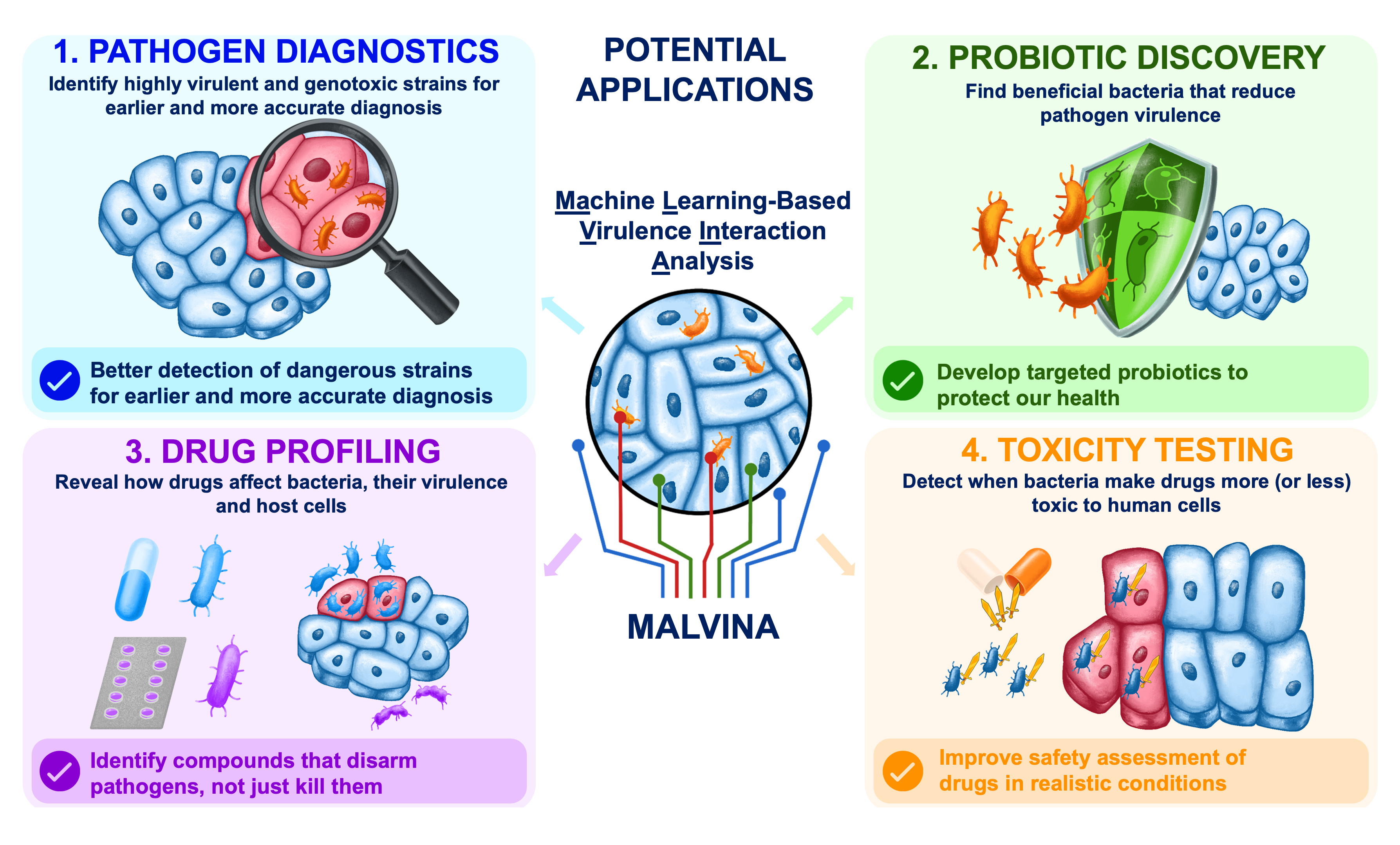
Potential applications of MALVINA in pathogen diagnostics, probiotic discovery, drug profiling, and toxicity testing by analysing bacterial virulence and host-cell responses. Graphic design: Enikő Koliger
MALVINA uses machine learning to reveal how bacteria invade human cells, cause DNA damage, and change their behaviour in response to microbes and drugs.
SZEGED, CSONGRáD-CSANáD, HUNGARY, October 12, 2026 /EINPresswire.com/ -- MALVINA reveals how bacteria invade and damage human cells — and why killing 99.9% of bacteria may not necessarily make the survivors less harmful.
When scientists assess how dangerous a bacterium is, the first question often seems simple: can it be stopped or killed? In microbiology and antibiotic research, one of the classic readouts has been whether a bacterium can grow in the presence of a given treatment.
But infection is not just a survival contest. What bacteria do near human cells can be just as important as whether they remain alive. Do they enter host cells? Do they spread across many cells, or accumulate in large numbers in only a few? Do they trigger DNA damage that may contribute to inflammation, tissue damage, or longer-term disease processes?
To address these questions, researchers at the HUN-REN Biological Research Centre, Szeged, and the Hungarian Centre of Excellence for Molecular Medicine developed MALVINA, short for Machine Learning-Based Virulence Interaction Analysis. The method detects fluorescently labelled bacteria inside human cells and uses machine learning to analyse microscopy images. This allows researchers to measure, in the same experimental system, how efficiently bacteria enter cells, how strongly they accumulate inside them, and what kind of DNA damage they induce.
“One of the strengths of the method is that we can see the details of infection cell by cell. We can distinguish whether a few bacteria enter many cells, or whether large numbers accumulate in only a few cells, while also measuring the damage they cause,” said Bence Bognár, co-first author of the study.
MALVINA changes the type of questions researchers can ask about bacterial virulence. In many studies, bacterial entry into cells, host-cell responses, DNA damage, and genetic background are measured separately. MALVINA connects these processes at the single-cell level.
This matters because the same total number of bacteria can hide very different infection patterns. In one case, many host cells may contain only a few bacteria. In another, only a small number of cells may be infected, but each of them may contain many bacteria. Conventional averaged measurements can make these situations look similar. MALVINA separates them.
The researchers first tested MALVINA on four different Escherichia coli strains. These included a harmless laboratory strain, disease-associated strains that can efficiently enter cells, and strains producing a DNA-damaging toxin. The method revealed distinct virulence profiles: some strains invaded many cells, some accumulated strongly in fewer cells, and others caused more pronounced DNA damage.
One strain isolated from a colorectal tumour sample stood out. Under the tested conditions, it showed strong invasive capacity, accumulated inside host cells and induced DNA damage.
“The special feature of this method is that we can see, within the same individual host cell, how many bacteria have entered and what damage the cell has suffered. This gives a much more precise picture of the consequences of infection,” said Szilvia Juhász, head of the Cancer Microbiome Research Group at HCEMM and corresponding author of the study.
Bacteria rarely act alone. In the gut, on mucosal surfaces, or in infected tissues, pathogens are surrounded by other microbes. The researchers therefore asked what happens when two bacterial strains encounter human cells at the same time.
An invasive E. coli strain associated with inflammatory bowel disease promoted the entry of an otherwise harmless laboratory strain into host cells. In other combinations, competition emerged: a genotoxic, DNA-damaging strain reduced the ability of non-genotoxic but invasive rivals to enter cells.
The team also examined colibactin, a bacterial genotoxin produced by some gut-associated bacteria. When colibactin production was disabled, the bacterium caused less DNA damage and was also less able to suppress the invasion of rival strains.
This highlights one of the study’s central messages: bacterial virulence is not always an isolated property of a single strain. It can depend on the microbial neighbours surrounding it.
The researchers then tested several compounds, including antibiotics and agents that can affect human cell functions. The results showed that some treatments reduced the number of viable bacteria while simultaneously increasing bacterial invasion into human cells.
In other words, drugs can do more than kill bacteria: they can also reshape virulence-related behaviour.
Because MALVINA measures both bacterial entry and host-cell response in the same system, it can help clarify whether reduced cell damage after treatment is simply due to fewer bacteria, or whether the surviving bacteria affect host cells differently.
“MALVINA is powerful because it does not look at bacteria in isolation. It shows how they behave inside human cells and in the presence of other microbes. Infection is therefore not just a matter of bacterial numbers, but a process shaped by host cells, neighbouring microbes, and drugs together,” said Viktória Lázár, an EMBO Young Investigator, group leader at the HUN-REN Biological Research Centre in Szeged, and corresponding author of the study.
The method could help identify particularly invasive or DNA-damaging bacterial strains, support the development of targeted microbiome-based or probiotic strategies, and contribute to the search for drugs that do not simply kill pathogens, but also disarm them by reducing virulence. A patent application has been filed for the MALVINA approach.
Infection, then, is not a simple numbers game. Bacterial behaviour is shaped by surrounding microbes, the drugs bacteria encounter, and the responses they trigger in human cells. MALVINA makes this previously hard-to-access single-cell story visible and measurable.
Zsuzsánna Réthi-Nagy
HCEMM Nonprofit Kft.
70917502
Visit us on social media:
LinkedIn
Instagram
Facebook
YouTube
X
Legal Disclaimer:
EIN Presswire provides this news content "as is" without warranty of any kind. We do not accept any responsibility or liability for the accuracy, content, images, videos, licenses, completeness, legality, or reliability of the information contained in this article. If you have any complaints or copyright issues related to this article, kindly contact the author above.
